Florida schools and high school athletic programs each ask for their own paperwork, and the forms are easy to mix up. This guide explains what’s required for school entry and for high school sports, what each form is called, and where in South Florida you can get them filled out.
Three different things schools may ask for
Most of the confusion comes from three separate requirements that often get lumped together as “the physical”:
- A school-entry health exam, required when a child first enrolls in a Florida school.
- Proof of immunization on the Florida Certification of Immunization, Form DH 680.
- A sports pre-participation physical on the Florida High School Athletic Association (FHSAA) form, required before a student can try out, practice or play for a member school’s team.
One doctor’s visit can often take care of all three, but each one has its own form and its own rules. Bring every form you have to the appointment.
The school-entry health exam
According to the Florida Department of Health, students in prekindergarten through 12th grade who are newly entering a Florida school need a health exam completed within one year before enrollment. This applies to kindergartners starting school and to older students moving to Florida from another state or country.
The state’s School Entry Health Exam form, DH 3040, is recommended but not required. A signed exam form from a U.S.-licensed provider that covers the same parts of the exam is also accepted, and students transferring from another state can use a comparable form from their old school. The Department of Health posts the DH 3040 in English and Spanish on its school enrollment page.
If your child is simply moving up a grade in the same Florida school system, they generally don’t need a new school-entry exam each year. Check with your school’s front office if you’re unsure.
Proof of vaccines: Form DH 680
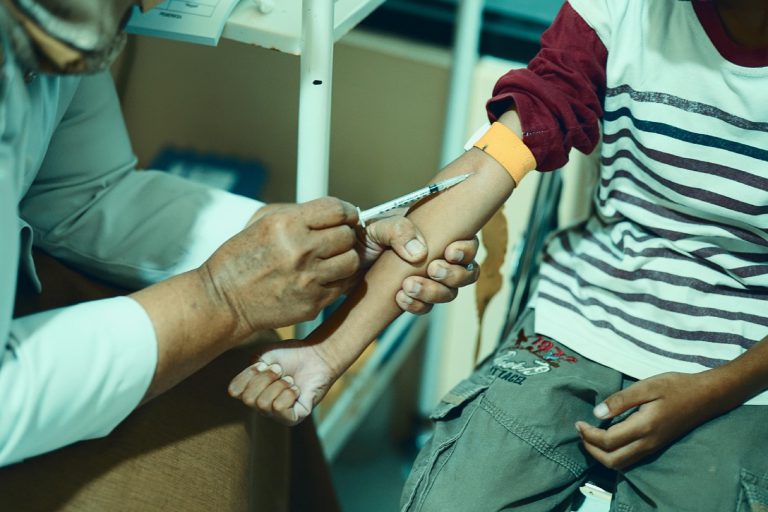
Florida schools and child care programs use the Florida Certification of Immunization, Form DH 680, to document the vaccines a child needs to enroll and attend. A few things to know:
- You can’t download it yourself. The Department of Health says the DH 680 is not available to the public. It has to be completed by a Florida-licensed physician, an advanced practice registered nurse, or a county health department.
- It usually comes from Florida SHOTS. Florida SHOTS is the state’s free immunization registry. Enrolled doctors’ offices can print a DH 680 with an electronic certification, and schools enrolled in the system can see it too.
- Moving from out of state? Get your child’s complete vaccine history before you leave. A Florida doctor or county health department will use it to fill out the DH 680.
- Seventh grade adds a requirement. The Department of Health lists one dose of Tdap (tetanus, diphtheria and pertussis) as an additional requirement for students entering 7th grade, so many families need an updated DH 680 that year.
Florida’s specific school vaccine requirements, and a proposal now under review to change some of them, are covered in our parent’s guide to Florida childhood vaccines. For the official list, see the Department of Health’s child immunizations page.
High school sports: the FHSAA forms
Students who play sports at an FHSAA member school need the association’s forms on file before they can participate. The FHSAA posts current versions under the “Parents” tab at fhsaa.com. As of the 2026–27 school year, the forms families most often need are:
EL2: Preparticipation Physical Evaluation
This is the sports physical. The current version is marked “Revised 2/26.” Key points from the form itself:
- It is valid for 365 calendar days from the date of the exam. Plan the visit so it doesn’t expire in the middle of a season.
- The student and parent fill out the medical history pages before the visit. The form includes a short mental health questionnaire along with questions about heart symptoms, past injuries and family history.
- The examiner must be a practitioner licensed in Florida as a medical doctor, osteopathic doctor or chiropractor, or as an advanced practice registered nurse (or hold equivalent licensure in the state where the exam was done). A clinician working under their direct supervision can perform the exam.
- The form isn’t considered valid unless every section is complete. Check for signatures, the exam date and the license number before you leave the office.
EL1: ECG screening (new in 2026)
Starting July 1, 2026, the FHSAA requires an electrocardiogram (ECG) screening, documented on Form EL1, for:
- All incoming 9th-grade student-athletes, and
- Students in grades 10–12 who have never participated in an FHSAA-sanctioned sport.
An ECG done on or after July 1, 2024 satisfies the requirement. Returning athletes aren’t required to have one, though the FHSAA encourages it. A physician can exempt a student using Form ME1. If the doctor recommends follow-up after the ECG or physical, that’s documented on Form EL1/2S. Ask your child’s doctor or a cardiology practice whether they can do the ECG, or ask your school’s athletic trainer about local screening events.
EL3: Consent and release
Parents sign the EL3. The FHSAA updated it in early 2026 to include state law language and says families must use the new version going forward.
Many South Florida districts collect these forms through an online athletic clearance system rather than on paper. Your school’s athletic director can tell you exactly what to upload and when.
Where to get a school or sports physical in South Florida
- Your child’s pediatrician or family doctor. This is usually the best choice because they know your child’s history and can update the DH 680 at the same visit. Summer slots fill quickly, so book early. Search pediatricians or primary care doctors near you.
- Urgent care and retail clinics. Many offer sports physicals. They may not be able to update vaccine records, so you may still need a separate visit for the DH 680. Find urgent care clinics by area.
- County health departments. The Florida Department of Health offices in Miami-Dade, Broward and Palm Beach counties provide childhood immunizations and can complete the DH 680. Call your local office to ask about exam services and appointments.
A simple checklist
- Find out whether your child is newly entering a Florida school (needs a school-entry exam) or entering 7th grade (needs Tdap).
- If they’ll play a high school sport, download the current EL2 and EL3 from fhsaa.com, and the EL1 if they’re a first-time high school athlete.
- Fill out the history sections at home, where you have records handy.
- Book one appointment and bring every form, plus any out-of-state shot records.
- Before you leave, check that each form is signed, dated and complete.
- Keep copies. The EL2 expires 365 days after the exam date.
A sports physical is a screening, not a full checkup. If your child has symptoms like chest pain, fainting or shortness of breath during exercise, tell the doctor, and don’t wait for the physical to bring it up.
Find a doctor for your child’s physical
SoFlo Doctors lists pediatricians, family doctors and clinics across Miami-Dade, Broward and Palm Beach counties. Start with our pediatrics directory, or search by location to find an office near your home or school.